A few months ago I wrote one sentence here that everything else grew out of: video is not the final product. It is the raw material. Since then, chapter by chapter, that sentence has rolled into places I did not plan in advance: onto the balance sheet, into the boardroom, up five floors of a pyramid. Time to stop, look back, and pack the whole thesis into one place.
So this is the chapter you can send as a single link to anyone who asks "what is it you keep talking about." And this is the full story.
The failure: investing in production, burying the result
Let's start with the facts we opened the series with, because they have not changed and they are still staggering: video accounts for roughly 82.5% of global internet traffic. More than 500 hours are uploaded to YouTube alone every minute. Roughly 90% of enterprise information is unstructured, and only about 10% of it is even stored. And even though 90% of the data is unstructured, most technology investment goes to the structured minority.
Read those four numbers in a row and you get the paradox of the decade: organizations have never produced so much content, and never used so little of it. The conference gets produced for hundreds of thousands, filmed with five cameras, and the next day it enters a cloud folder and disappears. Not because anyone decided to give up on it. Because there is no name, no framework, and no language for talking about what it really is.
My thesis is that this language already exists. It just sits in a different department.
The metaphor: why a stock, specifically
Consider what defines a stock. Not that it has value. For that, the word "asset" suffices. A stock is a very particular kind of asset:
Its value moves. It is not worth what you paid for it. It is worth what the market will give for it right now, and that changes every day, in response to actions and circumstances.
It pays without being sold. The dividend goes out, the ownership stays.
It is part of a portfolio. No serious investor holds one stock. They manage an allocation, balance, buy and sell.
And it demands management. A stock in a safe with no tracking is not an investment. It is a forgotten bet.
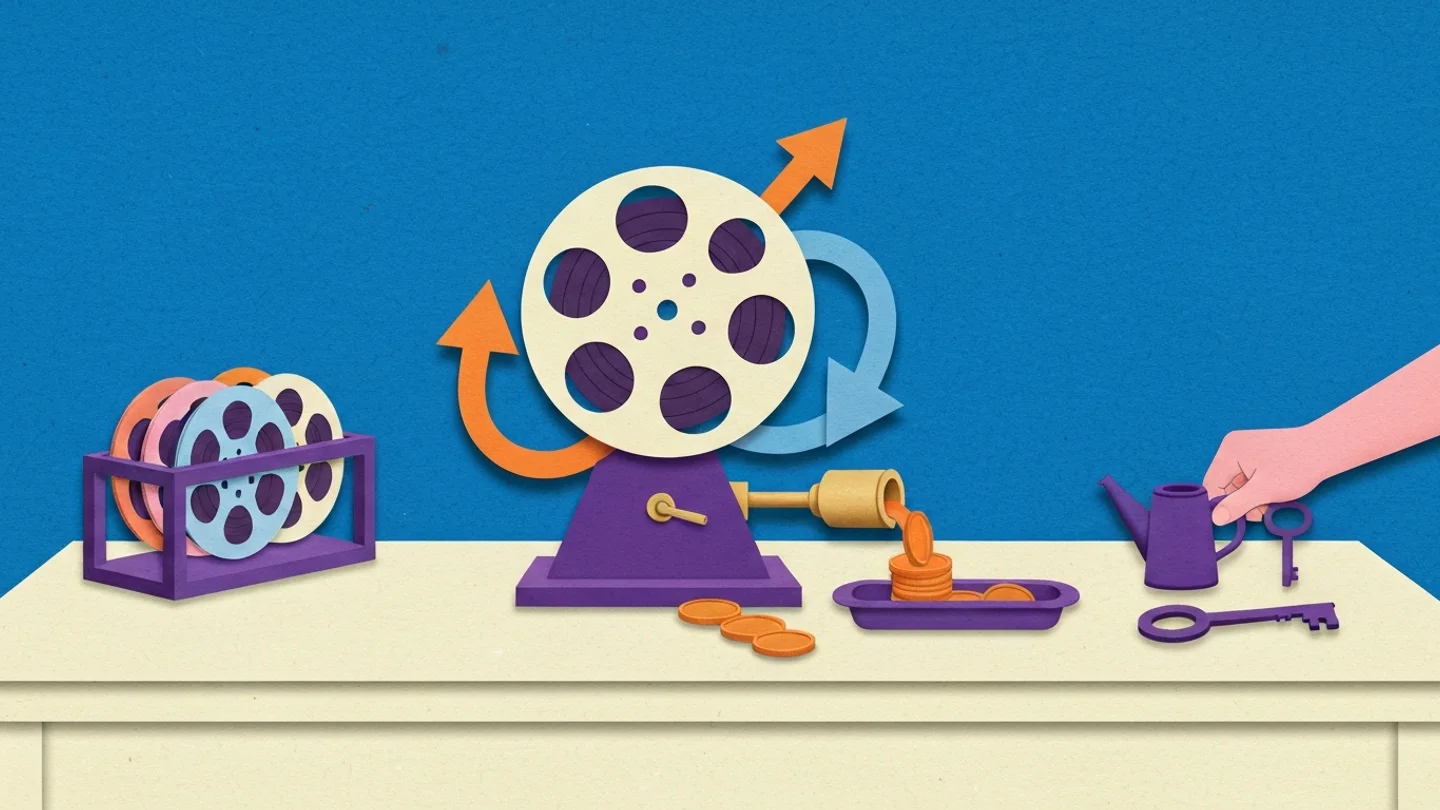
Now replace "stock" with "video" and read again. Every sentence stays true, and that is exactly what turns the metaphor from decoration into a working method: the talk whose value jumps when its topic returns to the headlines and erodes when it is forgotten. The clip extracted without harming the source. The library that is a portfolio, with evergreen blue chips and volatile news-driven picks. And the archive that, unmanaged, is not an asset but a forgotten bet.
And when a metaphor works all the way down, it comes with a dowry: a hundred years of investing practice, ready for use. That is what we did across this series. Here is the thesis in eight moves:
The thesis in eight moves
- 1. Video is raw material, not a productProduction is not the end of the process but its beginning: the moment of the IPO. Whoever treats filming day as the finish line leaves most of the value on the floor.
- 2. Its value rises and falls with our actionsBuilt-in depreciation erodes an untended asset: relevance decay, illiquidity, loss of context. And against it, the IPO, dividends, compound interest, and rebalancing raise it. The direction does not depend on the market. It depends on the owner.
- 3. What is not recorded is not managedThe video library appears on no balance sheet, and so it has no owner, no maintenance budget, and no metric. The fix requires no accounting revolution, just a shadow balance sheet: inventory, appraisal, return measurement. A managerial record that turns "more budget for content" into "improving an existing asset."
- 4. A portfolio needs a managerFour departments touch the asset, none owns it, and a committee is not an answer. The missing role: the Content Asset Manager, with one metric (return per asset), decision authority, and real time.
And from there, the pyramid. Because a managed asset needs infrastructure, and it is built five floors high:
- 5. The data layer is the due diligenceWho, what, when, and how, for every minute. A raw transcript is not data, just as a pile of numbers is not a financial statement. Only an attributed, anchored transcript turns a file into a documented record. And no floor will ever be more accurate than this one.
- 6. The insights layer is the analystFrom facts to meaning: the claims, the recurring patterns, the quotable moments, the story. Analytical coverage was once reserved for flagship events. Now every hour of video can be covered, and value that was hidden becomes visible.
- 7. The assets layer is the dividend, and the knowledge layer is the compound interestOne hour of a panel holds dozens of derivative assets, and the only barrier was the cost of search, which the lower floors eliminate. And above the standalone assets: a connected library worth more than the sum of its parts, one you converse with instead of rummage through, that becomes the institutional memory of the organization. An asset whose value accumulates with time, which makes starting early an advantage that cannot be caught up.
- 8. And the action layer is the portfolio managerThe floor that closes the gap between an answer and an outcome: not "where are the moments for sponsor X" but "find, package, and send." Operating within a mandate the organization set, supervised by the owner, and turning everything else from effort into a mechanism.
That is the thesis. And now, in the final chapter of the series, I want to add the part I have not yet said.
This is not a metaphor. It is a market.
Here I want to close one last loop, because after an entire series speaking the language of investing, someone is surely thinking: nice, but in the end this is just an elegant way to talk about content management.
It is not. And this is the part I most want you to take from this chapter:
Look at what is happening around us. Music publishing catalogs traded at an average of 16.1 times net publisher's share in 2024, and at the 2021 peak the average reached 19.4 times including the trophy catalogs. These are multiples most industrial companies never see. In April 2026 OpenAI bought TBPN, a daily tech talk show that had launched only seventeen months earlier, for a price the Wall Street Journal put in the low hundreds of millions, against about five million dollars of advertising revenue the year before: more than twenty times its prior year. And in May 2026, Netflix and Spotify paid a reported hundred million dollars for the video rights to a single podcast, Jay Shetty's "On Purpose."
Content royalties already trade as a genuine investment class. A Cornell University study of transactions on the Royalty Exchange marketplace found that life-of-rights music royalty assets returned about 12.8% a year over five years after transaction costs, with median annual dividends between 12.4% and 13.2%, in line with the S&P 500 over the same period. On that marketplace alone, rightsholders report having raised more than $200 million by selling royalty streams, across more than 2,500 completed deals.
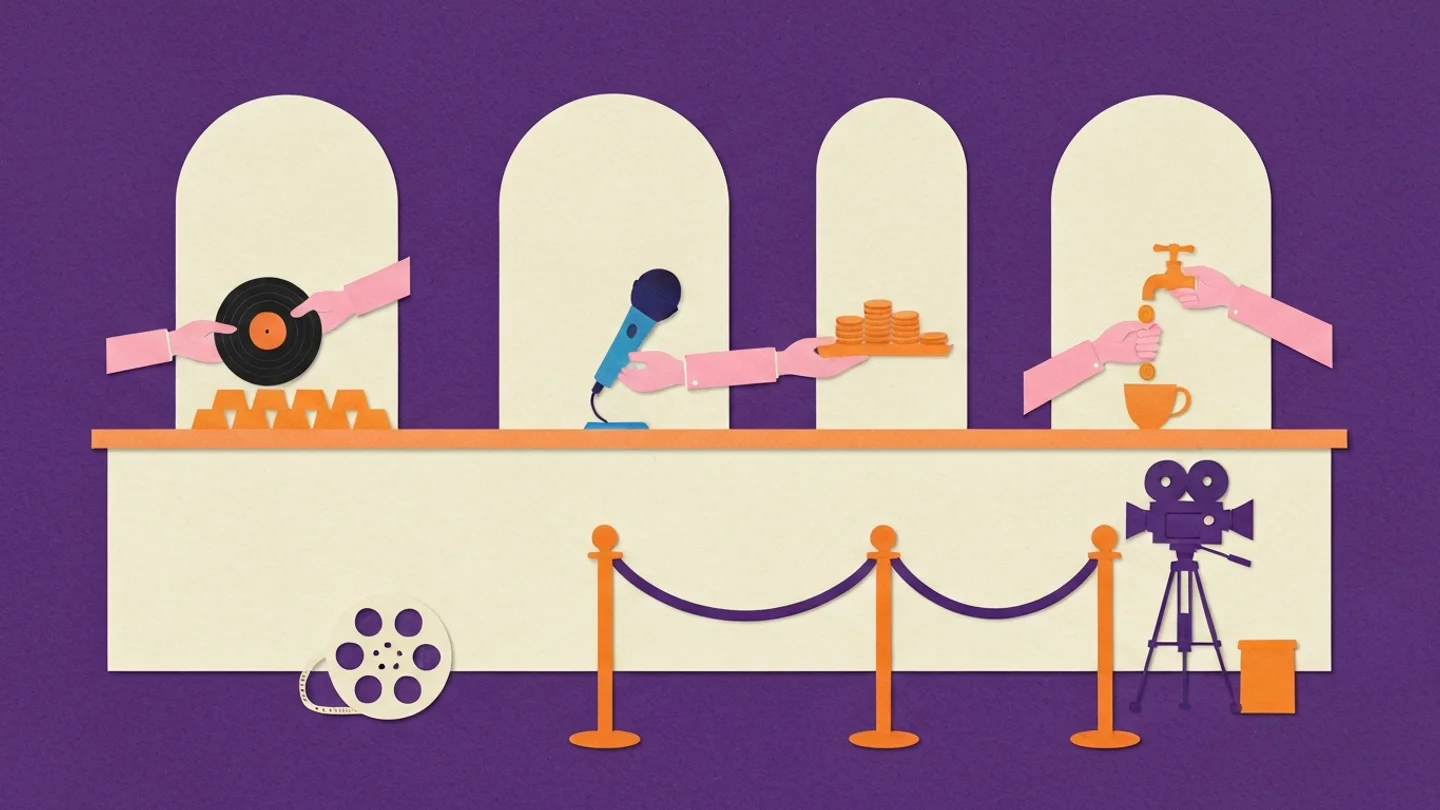
And the bigger picture behind it: by the end of 2025, according to Ocean Tomo's Intangible Asset Market Value study, intangible assets accounted for roughly 92% of the market value of the S&P 500, up from just 17% in 1975. The entire economy has already moved to the intangible side of the balance sheet. The market already knows how to price a song catalog, a podcast library, a channel. It simply has not reached your video library yet.
And that is precisely the point: enterprise video is not an exception to the rule. It is next in line. And whoever internalizes this early enjoys what every investor dreams of: standing in the asset before the market has priced it.
Because notice the advantages you hold in the meantime, while the market is still on its way:
- You are the issuerEvery camera that turns on in your organization is a new issuance, fully under your control: how much, about what, with whom.
- You are the sole ownerOne hundred percent of every asset, no dilution and no partners. Until you decide otherwise.
- And you set the valueAt this stage, before the external market prices it, the portfolio's value depends almost entirely on your actions: the five floors we built. The diligent investor wins.
But these advantages come with one condition, and it brings us back to everything this series has built: when the market comes knocking, it will only price what can be examined. A music catalog sells at a high multiple because every song in it is registered, rights-cleared, and measurable. A video library with no data layer, no shadow balance sheet, and no return metrics is not a tradable asset. It is a pile. The preparation for that market is exactly the pyramid.
What now
The market is already moving. AI-powered video analytics is projected to nearly triple by 2031. The technology exists. What is still missing is the discipline to measure what the library returns. What remains is the decision we opened the series with and will close it with: stop being archivists, and start being portfolio managers.
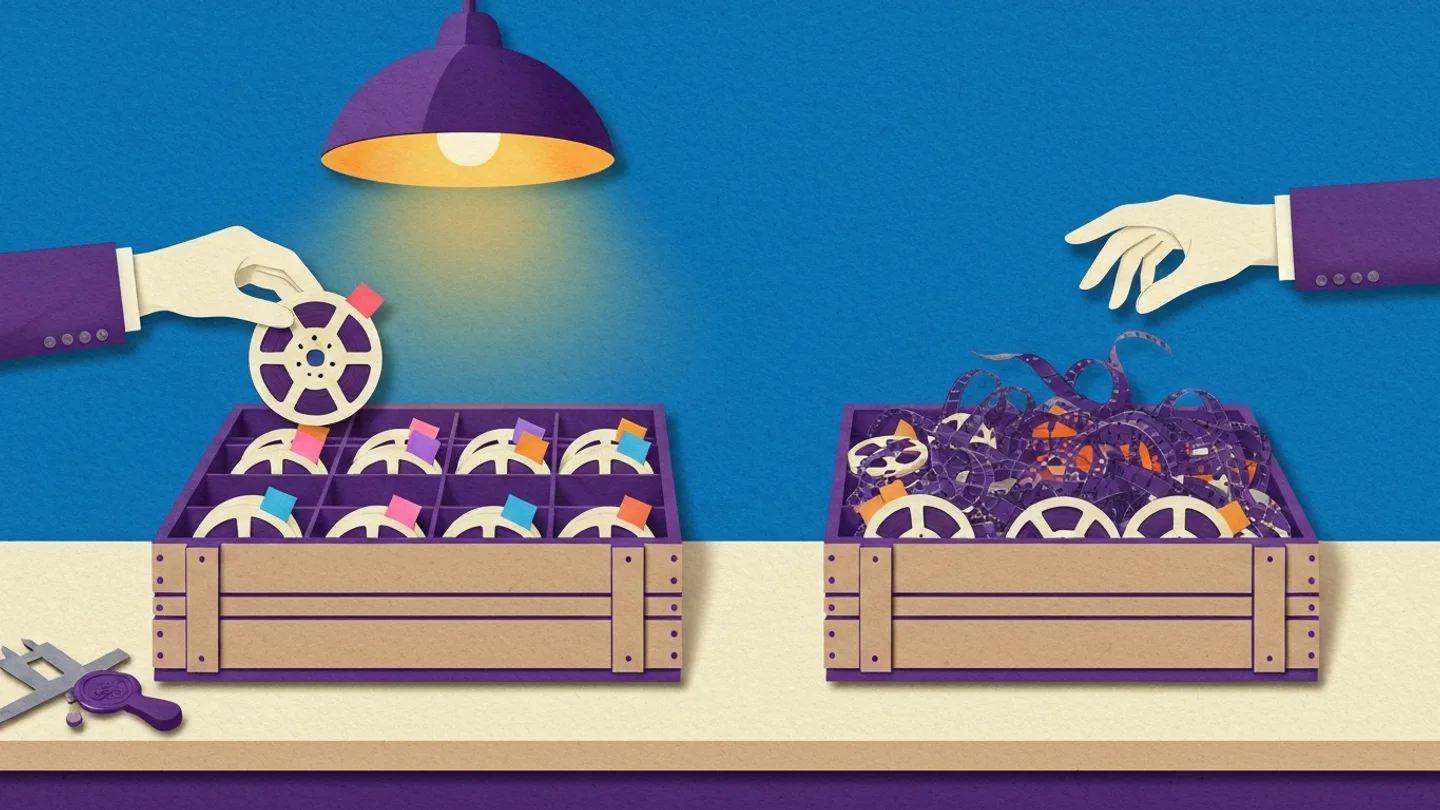
Every time a camera turns on somewhere in the world, a new stock is issued. Now you know exactly what to do with it.
Speechbox is the system building this, all five floors, from the due diligence to the portfolio manager. But the thesis is bigger than any system: video is an asset class. The market that prices content is already here. It just has not reached you yet, and the coming decade belongs to whoever is ready when it does.
Next time, we go exactly there: the secondary market for content. Who is already buying, who is already selling, what a deal on a video library looks like, and what needs to be in your portfolio so there is something to price.

Founder and CEO of Speechbox, a platform that turns enterprise video into an active knowledge asset.
Sources
- Billboard, on the Shot Tower Capital music catalog report. Publishing multiples averaged 16.1 times net publisher's share in 2024, against 19.4 times at the 2021 peak including iconic transactions. Billboard Pro, subscriber content.
- TechCrunch, OpenAI acquires TBPN. The acquisition, April 2026.
- TechStartups, OpenAI acquires TBPN. Price in the low hundreds of millions per the Wall Street Journal, about $5M of 2025 advertising revenue, show launched October 2024.
- Variety, Jay Shetty signs with Netflix and Spotify. A multiyear deal for the video rights to On Purpose, reported at about $100 million.
- Forbes, Jay Shetty strikes a $100 million deal. Exclusive rights to the video version of the show.
- Stoikov, Singla, Cetin and Cendra Villalobos, Music as an Asset Class (Cornell University). Life-of-rights music royalty assets returned about 12.8% a year over five years after transaction costs, comparable to the S&P 500.
- Royalty Exchange. The marketplace reports more than $200 million raised by rightsholders across more than 2,500 completed deals. Self-reported by the marketplace.
- Ocean Tomo, 2025 Intangible Asset Market Value Study. Intangible assets at roughly 92% of S&P 500 market capitalization at the end of 2025, against 17% in 1975.
- DemandSage, Video Marketing Statistics 2026. Video at roughly 82.5% of internet traffic.
- Statista, Hours of video uploaded to YouTube every minute. More than 500 hours per minute, figure last updated for 2022.
- Research World, Possibilities and limitations of unstructured data. 80 to 90% of new enterprise data is unstructured, and only about 10% of it is stored.
- Box and IDC, Untapped Value white paper. 90% of enterprise data is unstructured, and most technology investment goes to the structured minority.
- Mordor Intelligence, AI Video Analytics Market. USD 6.19 billion in 2026 to USD 17.23 billion in 2031, a compound annual growth rate of 22.72%.
Questions this raises
It exists and deals are closing in it. Music publishing catalogs traded at an average of 16.1 times net publisher’s share in 2024. In April 2026 OpenAI bought TBPN, a show that had launched seventeen months earlier, at a price the Wall Street Journal put in the low hundreds of millions. In May 2026 Netflix and Spotify paid a reported hundred million dollars for the video rights to a single podcast.
A Cornell University study of transactions on the Royalty Exchange marketplace found life-of-rights music royalty assets returned about 12.8% a year over five years after transaction costs, with median annual dividends between 12.4% and 13.2%, in line with the S&P 500 over the same period. That marketplace self-reports more than $200 million raised by rightsholders across more than 2,500 completed deals.
Because the economy has already moved to the intangible side of the balance sheet. By the end of 2025 intangible assets were roughly 92% of S&P 500 market value, against 17% in 1975. The market already knows how to price a song catalog or a podcast library. Enterprise video is not an exception to the rule, it is next in line.
It has to be examinable. A music catalog sells at a high multiple because every song in it is registered, cleared and measurable. A video library with no data layer, no shadow balance sheet and no return metrics is not a tradable asset. It is a pile.